September 2026, SCIDFoundation.org

A once-anonymous donor is now a permanent part of our lives, celebrating love, family, and the future he made possible.
In This Month’s Spotlight 

Arian and Dax – Sometimes, a lifesaving gift comes from someone you’ve never met. For Arian and his family, a stranger named Dax became the donor who gave their son a second chance at life. Their remarkable story is one of hope, gratitude, and a bond that continues to grow.
Who’s asking? – A new name has popped up in the PI space, and families are asking: who they are and what they want with our data. We break down the difference between research, community, and commerce.
Patient Stories
Arian’s Donor Story: A Story of Hope and Kindness
By: Victoria, SCID Mom
Cuddling my newborn, Arian, in the warm hospital room, the doctor walked in with the words we had prayed to hear: “We found a match.” It was a perfect match. The only details listed were “Male, 20 years old, O-positive blood.” After two anxious months of waiting, the transplant was finally a reality. Ahead of us lay eight days of conditioning and one day of rest to help my baby develop a functional immune system.
Every day, I wondered about this stranger. Who was he, and what inspired him to join the registry? Was he anxious or worried about the pain? I pictured a college student somewhere, just starting his own life, yet making a choice that would rewrite Arian’s future. It was the ultimate act of kindness, taking time to donate to an infant he knew nothing about, while our son waited in Los Angeles for his own life to begin.
On the other side of the country, that stranger had a name, Dax. Just weeks after matching, Dax put his college life on hold and traveled over 1,000 miles from Jonesboro, Arkansas, to Washington, D.C. Though he secretly worried whether the stem cell donation would work, he never hesitated. He simply did everything in his power to give our son a future.
For months, Dax remained a mystery to us. As Arian grew stronger, my gratitude only deepened, and I knew I had to say thank you. I officially submitted the Release of Information forms through DKMS (DKMS is affiliated with the National Marrow Donor Program), praying he would want to connect too. When the notification finally flashed on my cell phone screen, revealing his name and contact information, my heart raced. We shared our experiences, marveled at each other’s updates and exchanged pictures. Meeting the man who gave my son a second chance at life was an overwhelming wave of emotion, a moment where a stranger officially became family.
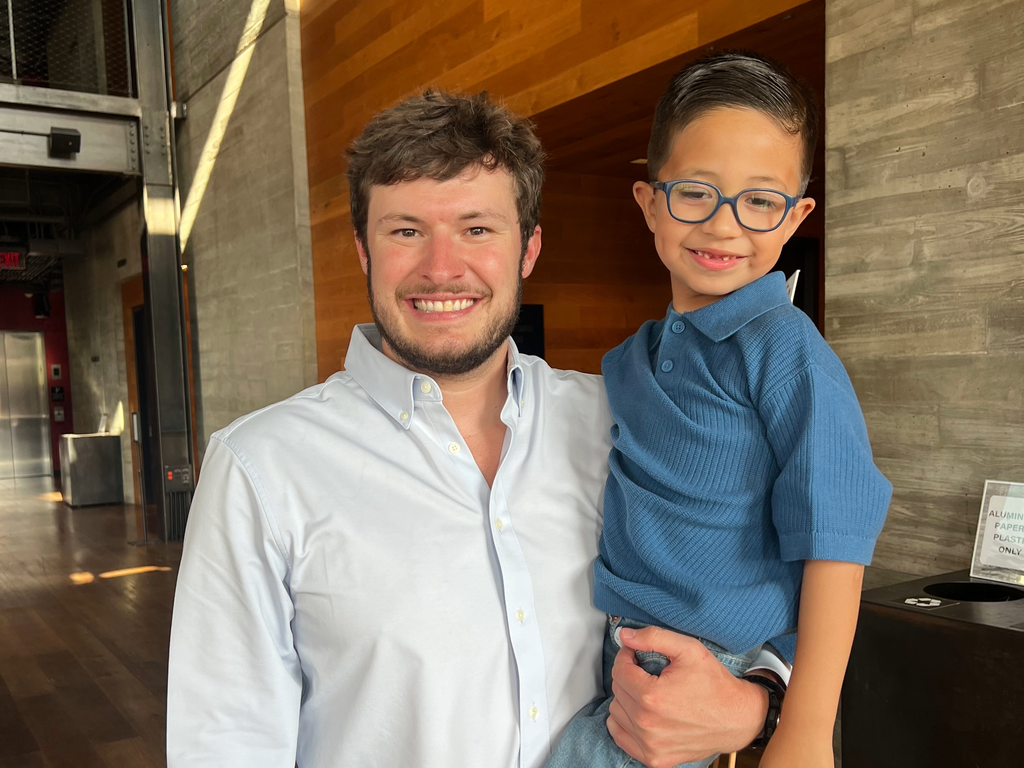
Arian met his hero three years after the donation. Dax and his entire family traveled to meet the baby they had prayed for, never knowing who he was. The moment we finally met in person was overwhelming. Watching Dax hold Arian, the boy whose life he had saved, brought our journey full circle. Two families from opposite sides of the country were instantly bound together, forever united by an unforgettable miracle.
A SCID diagnosis brought a lot of moments of sadness and fear. It brought crushing moments of uncertainty as we navigated an unknown future, but it also brought a beautiful bond; it brought hope and healing.
That bond has only deepened over the years, leading to an incredible milestone just this past July. Arian was invited to be the ring bearer at the wedding where Dax married his own perfect match, Jenna. We traveled to Arkansas and shared wonderful moments with his family, finally meeting the grandparents, siblings, and friends who had prayed for us throughout our journey.
Watching Arian walk down the aisle was the ultimate testament to Dax’s gift. A once-anonymous donor is now a permanent part of our lives, celebrating love, family, and the future he made possible.
Are you a SCID family with a story to share? Let me know. Email me at barb.ballard@SCIDFoundation.org.
Why Your SCID Data Is Valuable — And Who’s Asking For It
Recently, a new Facebook page and website related to Primary Immunodeficiency (PI) have appeared online, which has raised a few questions among rare disease families wondering who this new player in the PI space actually is.
Understanding Where Your SCID Data Goes
If your child has SCID, you’ve probably been asked more than once to share information about their diagnosis and treatment. When you or a family member has a rare disease, many different types of organizations may ask about your medical journey. Some are meant to benefit you or the SCID community as a whole, but you’ll want to understand who is asking the questions.
Sometimes that request comes from your immunologist or transplant team, inviting you into a research study like the one carried out by the Primary Immune Deficiency Treatment Consortium (PIDTC). Sometimes it comes from a nonprofit like the SCID Foundation, when you ask to join their community. And sometimes, it comes from a corporate-based website, inviting you to connect with “people like you.”
On the surface, all three ask for similar information, ranging from diagnosis to treatment history. But underneath, these are three different kinds of entities, and it’s worth understanding what sets them apart.
Research: value flows back to the community
Protocols 6901, 6902, and 6907 are run by the Primary Immune Deficiency Treatment Consortium (PIDTC), a network of academic transplant and immunology centers under Institutional Review Board (IRB) oversight. 6901, which is now closed to new patients, followed patients prospectively from before treatment; 6902 looked backward at decades of outcomes; 6907 continues the work today following newly diagnosed patients with SCID, regardless of treatment path. Your doctors gather information from your regular visits and compile it, stripped of identifying details, to help improve treatment options for future families or to better understand long term outcomes. The people asking are the same people caring for your child, and the data flows into medical research, not a marketing pipeline.
Where a nonprofit like the SCID Foundation fits in
The SCID Foundation, and patient organizations like it, are donation-funded, board-governed, and built specifically around the patient community, offering education, advocacy, connection, and family support. When a foundation collects your information, it is generally to serve that mission directly. The information shared allows the organization to connect with families who share unique challenges. It’s still reasonable to ask what a foundation does with your information and whether it shares data with sponsors. But the underlying relationship is different: a foundation exists to support its community and is accountable to it.
What a commercial backed site actually is
A commercial site looks similar to both of the above, support, community, shared experience, and it’s a resource some people find helpful. It’s worth noting that the site mentioned in the first paragraph operates as part of a larger family of businesses. That parent company’s publicly stated work includes helping healthcare and pharmaceutical companies understand and reach patient communities, and it sells patient data to them for a fee. When you join a platform of this nature, its terms of use typically explain how your information may be collected, used, and shared, often in ways that go beyond the platform itself. That’s a different arrangement than a research consent form reviewed by an ethics board, or a donation-funded nonprofit, and it’s worth reading those terms with that context in mind rather than assuming they all work the same way.
Before you say yes
Two questions cover most of it: Who is asking, and where does this information go?
- A medical team operating under an Institutional Review Board (IRB)-reviewed study → research.
- A donation-funded organization serving the patient community → nonprofit.
- A company whose business includes connecting patient data with industry partners → commercial platform, worth a closer read before joining.
Standing Beside Our Families
This month’s newsletter holds two sides of the same devotion: the joy of watching a family embrace the stranger who gave their son a second chance at life, and the quieter work of understanding what it means to protect the health data our families generate every day. Both are acts of love. Both remind us that healing is never just physical — it’s relational, and it’s rooted in trust.
Part of our mission is helping families understand their own health information: what’s collected, who it’s shared with, and what those choices mean for them and their children over a lifetime of care. Knowledge is protection. The more families understand their data, the more empowered they are to make informed decisions about it.
At the same time, we know that sharing your story, the hard parts and the hopeful ones, is one of the most powerful things a family can do. When you share your journey with the SCID Foundation, you’re not just processing your own experience; you’re lighting the way for another family who is just beginning theirs. Privacy and openness aren’t in conflict here, they’re both part of how we care for one another, on our own terms.
Your generosity allows the SCID Foundation to walk beside families through every chapter: celebrating reunions that bring tears of gratitude, teaching families to navigate their own data with confidence, and creating space for stories that help others feel less alone.
Together, we are building a future where every SCID family has the knowledge, protection, and community they deserve.
Know someone in the SCID Community who could use our news?
Encourage them to Sign up!