March 2026, SCIDFoundation.org
Even when plans change abruptly and painfully, compassion and connection can still grow.
We’re glad you’re here. Here’s what you’ll find in this edition of the SCID Foundation newsletter.
Nodica’s story – Nodica was devastated to learn that her dream of nursing her second son was cut short when his newborn screening test reported that he could have SCID. Read how she found a solution that helped another mom while easing the pain of loss she experienced.
Plain Language Summaries – What is the purpose of plain language summaries, and how can they help you understand medical research articles?
chatSCID – A program designed to bring the SCID community together in real time. If you are a SCID patient or caregiver, join us for the next event!
Reminder: The SCID Adult Survivorship Survey will remain open until April 7th. SCID patients 18 and older, regardless of genetic subtype, who were treated with a stem cell transplant (HSCT or BMT), gene therapy, enzyme replacement therapy, or a combination, are asked to participate.
Patient Stories
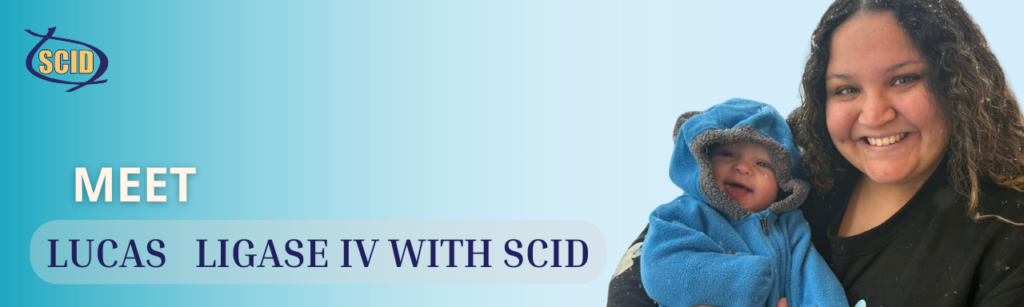
Meet: Nodica and Lucas
By: Nodica, SCID mom
I am Nodica, a mother to two wonderful boys: Elijah, age three, and Lucas, who is six months old. My pregnancy with Lucas was everything I had hoped for: smooth, uncomplicated, and healing in ways I didn’t expect. Lucas was born on August 30, and those first moments felt nothing short of miraculous.
We left the hospital when Lucas was just two days old, believing we were bringing home a healthy newborn. Our only challenge was breastfeeding, something I trusted we would figure out with time. Breastfeeding was something I deeply hoped to experience with Lucas, while also believing strongly in protecting maternal mental health and that “fed is best.” Like many parents, our feeding journey didn’t go as planned. I struggled early on and briefly transitioned to formula while pumping minimally for my own well-being. Eventually, I decided to try again, working through latching difficulties as Lucas and I learned together.
On September 4, Lucas latched successfully on the first attempt during a feeding. It was a moment of joy for our family, a small victory after days of uncertainty. Thirty minutes later, I received a call from his pediatrician advising me to stop breastfeeding and come in the following morning for further evaluation.
The next day, we learned that Lucas’s newborn screening had flagged for Severe Combined Immunodeficiency (SCID), a rare and serious condition affecting the immune system. The diagnosis was completely unexpected and immediately changed how we cared for our newborn. At first, we were told it could be a false positive and not to worry until further testing was done. I held onto that possibility with everything I had and tried to stay positive.
While we waited for confirmatory testing, I was informed that I would also need to be tested and that the likelihood of being able to safely breastfeed or provide expressed milk was very low. When Lucas’s diagnosis was officially confirmed on September 15, at just 15 days old, our focus shifted entirely to protecting his fragile immune system and minimizing any risk of infection. I continued pumping throughout September, holding onto hope while processing how suddenly our plans and expectations had changed.
On October 1, at one month old, Lucas received his first IVIG infusion, and we learned the genetic cause of his SCID: Ligase IV syndrome. Ligase IV is a protein the body uses to repair breaks in DNA. When it does not function properly, cells, especially immune cells, cannot repair themselves correctly. This leads to a severely weakened immune system and makes it difficult for the body to fight infections, which is why strict precautions and specialized medical care are required. In addition to SCID, Ligase IV syndrome can also cause radiation sensitivity, stunted growth, microcephaly (a smaller head size), developmental delays, and an increased risk of cancers such as lymphoma and leukemia.
Around that time, I received final confirmation that my breast milk could not be used for Lucas, and I made the heartbreaking decision to stop pumping. Although this marked the end of a deep personal goal, I had built a substantial frozen milk supply. After stopping, I didn’t know what to do with the milk I had worked so hard to collect. I considered donating locally or through milk banks, but I struggled to find the right time and place. Letting go of something that should have been meant for my son was emotionally heavy. With Lucas’s constant appointments and care, donation plans were pushed aside, especially when, on January 21, we were medically flown two states away for treatment.
While away from home and awaiting transplant following other treatments, I came across a local request from a mother seeking donor breast milk for her four-month-old baby girl. The moment I saw her post, I felt certain in my heart that this was the family I was meant to help. After connecting, I shared information about my health, medications, and lifestyle, along with the testing I had undergone while pumping. I was transparent about my son’s condition so she could feel confident in the safety of the milk. Although she offered to pay, I knew from the moment I decided to donate, that this milk would be given freely.
A few days later, my husband delivered the milk to her family. In that moment, I felt an overwhelming sense of peace. The milk I had worked so hard to collect would now nourish another baby in need. Her mother was doing everything she could to rebuild her milk supply, and I hope this donation gives her the time and support she needs to continue feeding her baby in the way her heart desires.
What began as a painful reminder of loss became an opportunity to give. Donating my breast milk allowed me to turn a difficult chapter into something meaningful. It reminded me that even when plans change abruptly and painfully, compassion and connection can still grow from what remains.
Our journey is far from over. Lucas continues to face isolation, treatment including a stem cell transplant (HSCT), and the lifelong care required for his condition. But the chapter of my breastfeeding and milk donation journey has come to a healing close, one rooted in love, resilience, and the quiet power of helping another family when we needed hope the most.
Making Research Accessible: A New Plain Language Summary
Articles on medical research are usually written by clinicians and researchers. These articles can be cumbersome for the layman to read and digest, but patients, families, and caregivers deserve to understand what that research means for them, too. That’s the idea behind plain language summaries: short, jargon-free translations of scientific articles written so that anyone outside the medical field can grasp what researchers found and why it matters to them. Rather than replacing the original study, a plain language summary opens the door to it.
A great example is the recently published study Outcomes Following Matched Sibling Donor Transplantation for Severe Combined Immunodeficiency: A Report from the PIDTC. The research looks at children born with SCID and examines how they fared after receiving a blood or marrow transplant from a matched sibling donor.
The Center for International Blood and Marrow Transplant Research (CIBMTR) has published a plain language summary of this study that walks through the key findings in clear, everyday language, no medical degree required. For families navigating a SCID diagnosis, or advocates working alongside them, this kind of resource is invaluable. It empowers people to ask better questions, have more informed conversations with their care team, and feel less alone in a complicated process.
We encourage you to read it and share it widely.
chatSCID
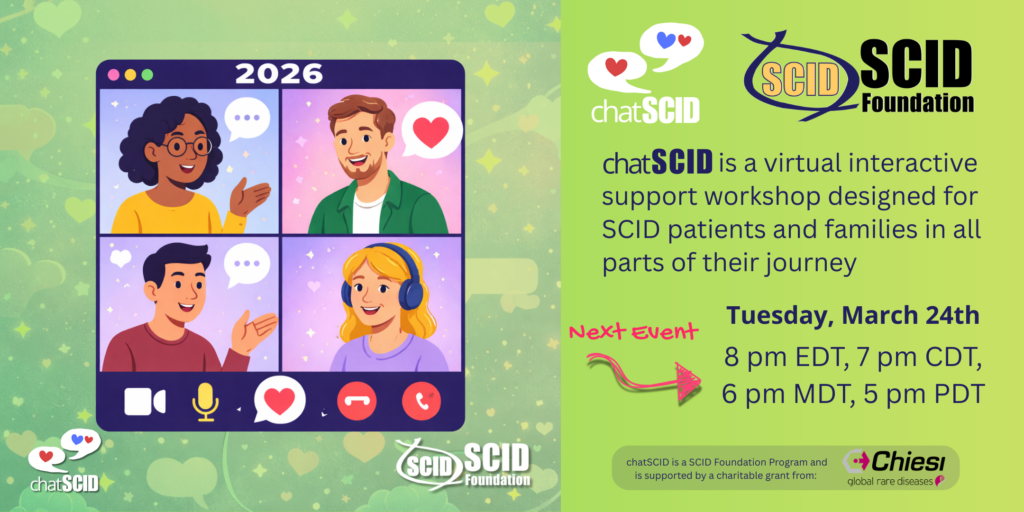
chatSCID is a monthly one-hour virtual meet-up designed for SCID caregivers and adult patients at any stage of their journey.
This program provides a supportive space for open discussions, questions, emotional support, and education exclusively for SCID patients and families.
We encourage SCID families who have already been through treatment to give back by sharing their experiences, offering guidance and hope to others.
For families new to the world of SCID, chatSCID is a place to connect, ask questions, and learn from those who understand the challenges firsthand.
The next chatSCID is scheduled for Tuesday, March 24th at 8:00 pm EDT, 7:00 pm CDT, 6:00 pm MDT, 5:00 pm PDT.
Registration is free and open to all SCID families. Come join a community built on support, learning, and encouragement.
Reminder: Adult SCID Patient Survivorship Survey
The SCID Adult Patient Survivorship Survey is still open. If you are an adult SCID patient, 18 years of age or older, we need your participation in a research study designed to better understand the long-term health, medical, and life outcomes of adult survivors of Severe Combined Immunodeficiency.
Parents of adult patients, please find out if your son or daughter has completed the survey. A parent or caregiver may complete the survey for the patient if they cannot or will not do so themselves, but only 1 survey should be completed per patient.
The survey can be found at: https://www.surveymonkey.com/r/3S8RXJL
If you have any questions, please contact
Barb Ballard
SCID Foundation
Barb.Ballard@SCIDFoundation.org
or
Joud Hajjar, MD, PhD, MS, FAAAAI, FCIS
Service Chief, Adult Allergy and Immunology
Baylor College of Medicine and Texas Children’s Hospital
Division of Immunology, Allergy & Retrovirology
joud.hajjar@bcm.edu
Stronger Together
There are so many ways to support this community. Follow us on Facebook for updates and resources, share your story for a future newsletter, or turn an upcoming milestone into a birthday or Life Day fundraiser.
If your employer offers a matching gift program, your donation can go even further.
Whether you give your time, your story, or a financial gift, every contribution helps ensure families affected by SCID have the support and knowledge they need. I’d love to hear from you — just reply to this newsletter or reach out at the email below.
Know someone in the SCID Community who could use our news?
Encourage them to Sign up!