February 2026, SCIDFoundation.org
To save his life, Jake needed a bone marrow transplant. As a 50-50 match to my son, I was able to be his donor.
In This Month’s Spotlight
Calling All Adult SCID Patients – Your voice is needed now! To identify gaps in care, inform future clinical guidelines, and improve lifelong, adult-centered care for individuals with SCID, the SCID Foundation urges ALL adult SCID patients to complete a 15 to 20-minute survey. We have continued to advocate for greater attention to the needs of the adult SCID community. This is your opportunity to be heard!
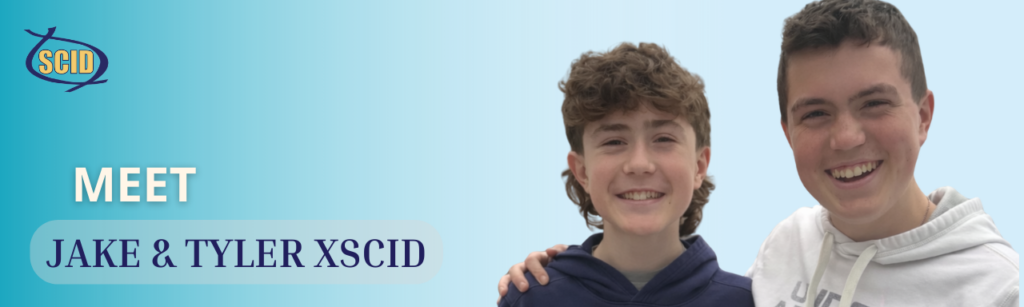
Jake & Tyler’s XSCID Journey – A heartfelt story from a mom who shares her experience raising two boys with X-linked SCID, highlighting the challenges, triumphs, and the support that got her through.
Rare Disease Day 2026 – Learn how to become part of the global movement on February 28th to raise awareness for SCID and show support for families living with rare diseases.
I hope these stories inspire and encourage you as we work together to raise awareness and support families affected by SCID.
Calling All Adult SCID Patients
The SCID Foundation is proud to collaborate on a SCID Adult Survivorship Survey, and we need your help! We urge all adult patients, or their caregivers, to take a few minutes to complete the survey linked below. Your identity and personal information will be anonymized. No one will contact you based on your answers or information provided.
The SCID Adult Survivorship Survey is a research study designed to better understand the long-term health, medical, and life outcomes of adult survivors of Severe Combined Immunodeficiency (SCID).
Although advances in hematopoietic stem cell transplantation (HSCT) and gene therapy (GT) have significantly improved childhood survival, there remains limited data on adult outcomes, including immune follow-up, healthcare access, reproductive health, employment, insurance stability, and quality of life.
This survey aims to capture patient-reported outcomes and lived experiences that are not routinely collected in clinical care or existing research registries. The findings will help identify gaps in care, inform future clinical guidelines, and support advocacy efforts to improve lifelong, adult-centered care for individuals with SCID.
The survey will only be open for a limited time. Please make time to participate today.
Who is eligible to participate:
- Adults 18 years of age or older, diagnosed with Severe Combined Immunodeficiency (SCID), regardless of genetic subtype
- Survivors treated with hematopoietic stem cell transplantation (HSCT/BMT), gene therapy (GT), enzyme replacement therapy (ERT), or a combination
- Participants may currently reside anywhere globally
- Participants may have been treated at any medical center
- Patients are encouraged to complete the survey themselves when possible; however, a caregiver or family member may complete the survey on their behalf.
About the investigator and collaboration:
The study is led by Joud Hajjar, MD, PhD, MS, Associate Professor of Medicine, and Service Chief of Adult Allergy and Immunology at Baylor College of Medicine and Texas Children’s Hospital. This work is conducted in collaboration with the CIS Adult Immunodeficiency Committee, bringing national expertise in adult inborn errors of immunity to the study.
Dr. Hajjar’s research focuses on long-term outcomes after childhood treatment of immunodeficiency, immune dysregulation and autoimmunity, transition from pediatric to adult care, reproductive health, and survivorship in adults with complex immune disorders.
Go to the Survey: https://www.surveymonkey.com/r/3S8RXJL
If you have any questions, please contact:
Barb Ballard
SCID Foundation
Barb.Ballard@SCIDFoundation.org
or
Joud Hajjar, MD, PhD, MS, FAAAAI, FCIS
Service Chief, Adult Allergy and Immunology
Baylor College of Medicine and Texas Children’s Hospital
Division of Immunology, Allergy & Retrovirology
joud.hajjar@bcm.edu
Patient Stories
Meet: Jake & Tyler
By: Lisa, SCID mom
I am Lisa from Connecticut, and I am the mother of two boys with X-linked SCID (XSCID). My motherhood journey started in 2009 when I had my first baby, Jake.
Jake was a happy and healthy baby weighing 7 pounds, 14 ounces. My husband and I enjoyed the first six months of his healthy life, while marking all his milestones. He had nothing but green flags.
When we celebrated his six-month birthday, however, we noticed there was something different going on with him. His breathing was different, and it seemed as if he couldn’t get enough air. We decided to have him checked out by his pediatrician. His doctor realized that his oxygen levels were very low and immediately sent him to the hospital. Once we arrived, they put him on oxygen and ran tests to find the problem. He tested positive for pneumonia. They figured that was the reason for his low oxygen levels.
Three weeks went by, and his need for oxygen did not improve. They continued to run every test and X-ray they could offer, and still could not find the problem. Immunologists were called in, and they gave me the most devastating news. My son was born with a very rare disease, Severe Combined Immune Deficiency (SCID), also known as the “Bubble Boy” disease.
Unfortunately, there were no hospitals in Connecticut that treated SCID. Our doctors told us about a few hospitals out of state that could treat it. We did our research and then packed our bags to head down to Durham, North Carolina, where Duke Hospital was located, and where the great Dr. Rebecca Buckley practiced.
Dr. Buckley was very dedicated and knowledgeable in the field of SCID. To save his life, Jake needed a bone marrow transplant. As a 50-50 match to my son, I was able to be his donor. We stayed in North Carolina another four months to see if the procedure worked, to monitor for graft-versus-host disease, and to find out if he had working T cells.
We were blessed with the amazing news that the transplant had worked and that he had functioning T cells! We were finally able to head back home and be a family again; however, Jake still had to be isolated at our home for another six months.
What my family and I went through was terrifying, and I did not want that to happen to any other family. I volunteered to advocate in the state of Connecticut, working toward the passage of legislation to require a newborn screening test for SCID, so no family would have to face this agonizing experience again. Newborn screening legislation was passed in Connecticut the following year.
We knew that we always wanted Jake to have a sibling. We also knew there was a 50% chance another boy would have SCID. We decided to put it in life’s hands and have a second child to be Jake’s younger sibling. In 2011, we were expecting another baby who would be born on January 3rd, 2012. We decided to head back to North Carolina to deliver this baby at Duke Hospital, to be prepared. I gave birth to another boy, and we named him Tyler. Tyler was immediately tested and was found to be positive for XSCID.
Once again, Dr. Buckley saved us. She was able to transplant him using me as his donor only 16 days after his birth. It was so much easier transplanting Tyler because we were now experienced and educated after having gone through this dreadful experience with Jake. Also, because he was tested right at birth, everything went through much more smoothly. After four months, the boys and I headed back home to Connecticut.
Both of my boys are living healthy lives and are doing what normal children their age do, despite needing IgG replacement therapy every two weeks. Jake is now 17 years old and will soon be heading into his senior year of high school. We are starting to look for colleges. Tyler is now 14 years old and will be going to high school next year. He plays ice hockey and runs.
I am so grateful for the doctors and modern medicine, my friends, and my family who supported me throughout the ups and downs of this journey, and also for the SCID community that got us this far.
February 28th is Rare Disease Day
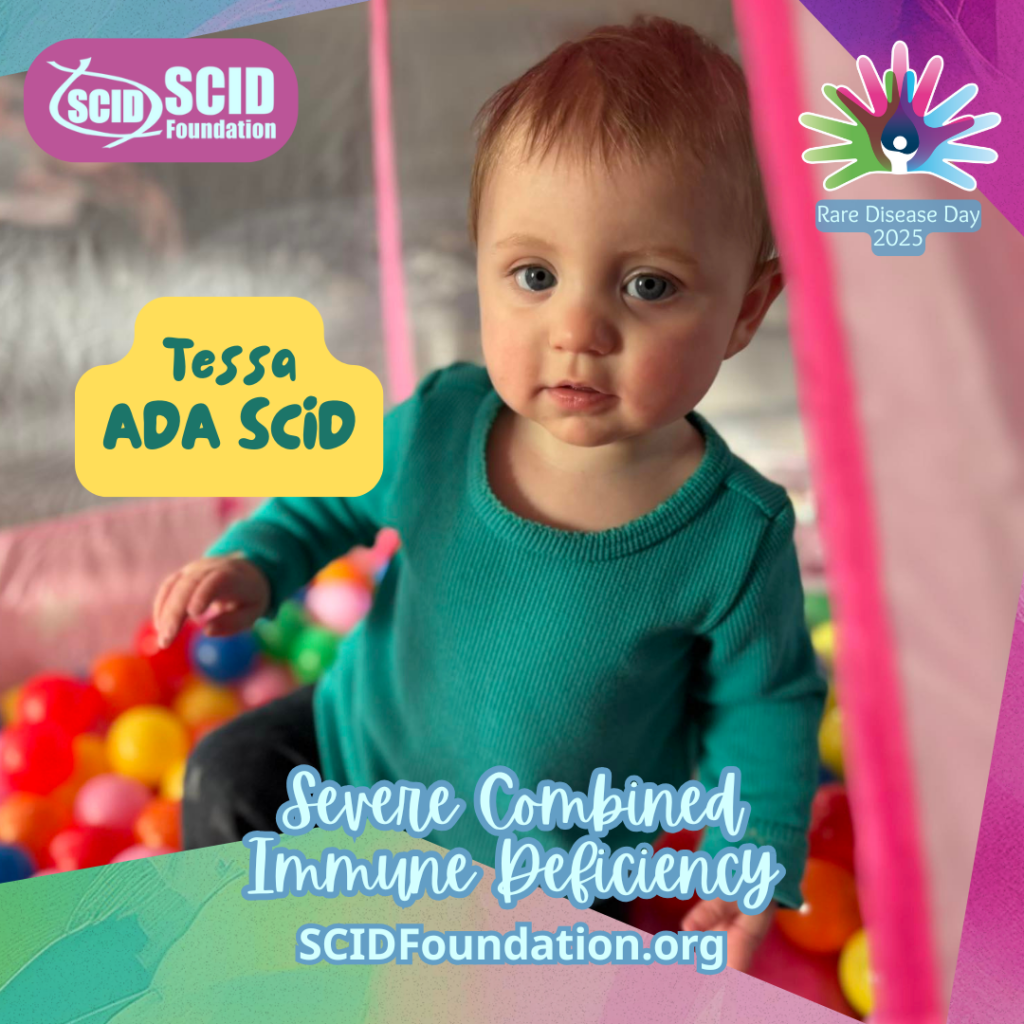
Rare Disease Day is a global movement that shines a light on more than 300 million people worldwide living with rare diseases, including those affected by SCID. Today, and every day, we recognize all those who make up this community and work to create meaningful change. Join us in raising awareness for Severe Combined Immune Deficiency (SCID) and standing with families who face this diagnosis every day.
Customize our FREE Rare Disease Day social media template to create your profile picture. Add your own photo to share your story, honor a loved one, or show your support for the SCID community. Every post helps educate, strengthen advocacy, and remind more families they are not alone!
 Download your 2026 template here:
https://www.scidfoundation.org/rare-disease-day-2026/
Together, we can create awareness, and ensure no family faces SCID alone. Thank you for supporting the SCID Foundation. 

Quick Fact: There are at least 20 different genetic variants that can cause SCID.
If You Believe No Family Should Face SCID Alone…
SCID is a rare, life-threatening disorder that leaves children without a working immune system. Families are suddenly faced with hospital stays, isolation, and overwhelming medical decisions.
The SCID Foundation provides trusted education, advocacy, and financial support created specifically for SCID families. But we can only do this with your help.
If you believe no family should face SCID alone, please consider making a gift today. You can also support our mission by sharing our posts on social media or volunteering.
Together, we can walk beside every SCID family—every step of the way.
Know someone in the SCID Community who could use our news?
Encourage them to Sign up!