
November 2026, SCIDFoundation.org
I had never even heard of SCID before our diagnosis, and now I’ll talk about it anywhere, anytime, to anyone who will listen.
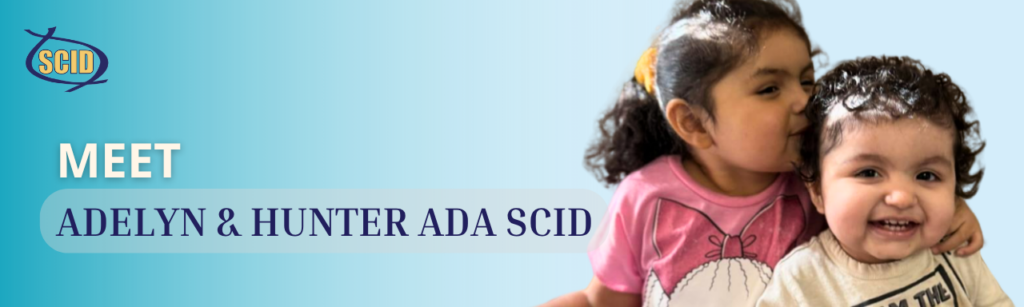
In this issue, you’ll learn how Adelyn & Hunter’s mom became a SCID advocate after 2 anonymous donors saved the lives of her children.
You’ll also learn how transitioning from isolation back into the world can be exhilarating, but also scary.
Don’t forget to join us for the final chatSCID of the year. All SCID families are encouraged to join us for an evening of conversation and compassion. SCID Dads are encouraged to participate as well.
Patient Stories
Meet: Adelyn & Hunter
By: Vanessa, ADA SCID mom
When my husband and I welcomed our second baby girl, Adelyn, in December of 2021, we thought she was perfectly healthy. Seven days later, we learned she had failed part of her newborn screening. We were told that these results are often false positives — but this time, they weren’t.
Even though we were isolating, Adelyn caught a cold around the same time we received confirmation from our immunologist: She had ADA SCID. She was admitted to our local children’s hospital and given IVIG (intravenous immunoglobulin), but our town didn’t have the specialists she needed. In late January 2022, she was airlifted four hours away to a larger medical center.
Adelyn battled rhinovirus for five long months before she was well enough to be considered for a bone marrow transplant. During that time, she was on oxygen for two months and received enzyme replacement therapy (ERT) for twelve weeks. In May 2022, she finally cleared the virus. We were discharged later that month, returning at the end of June to begin her transplant process.
In June, an anonymous person from Europe graciously donated their marrow for my daughter. Adelyn received eight days of chemotherapy. Thankfully, she tolerated it well with just a few days of discomfort, after which she bounced right back. After 49 days in the hospital, we were discharged, but we had to stay near the hospital for three more months while she recovered. Her post-transplant journey went smoothly, with no major complications. In time, Adelyn reached the milestone of only needing yearly follow-ups, which felt like such a victory.
Our story didn’t end there. While we were adjusting to life at home after a long and difficult year, I found out I was expecting our third child. We were excited but also scared. We knew the risk of SCID, yet we stayed hopeful.
In August 2024, our son Hunter was born. Just like Adelyn, he tested positive for ADA SCID. This time, we didn’t wait. We knew what it meant and started treatment as quickly as possible. At 30 days old, Hunter received his first ERT injection. Around that time, just like Adelyn, he tested positive for a common cold but stayed completely symptom-free. After two weeks on ERT, our team decided the time was right to move forward with transplant.
Chemotherapy began in early November 2024, and Hunter was transplanted on November 20th using the marrow of another anonymous donor from Europe. He surprised everyone by breezing through those inpatient days. He never needed a feeding tube, pain pump, or IV nutrition. After 39 days, he was discharged to a nearby Ronald McDonald House while we waited for his new cells.
However, after passing the 100-day post-transplant mark, Hunter developed a bacterial infection in his gut. He was started on antibiotics and seemed to recover, but in late March, things took a sharp turn. I rushed him to the ER when he stopped eating, smiling, and being his usual happy self.
The next day, he became very swollen, and no pain medicine was helping. Late that night, Hunter was moved to the ICU. Our doctors told us he was battling severe VOD (veno-occlusive disease) and possibly other serious complications. His oxygen needs increased, and he was eventually intubated.
For eight days, Hunter fought through VOD and sepsis caused by an infected central line. He spent a month on continuous medications, but slowly, he recovered. The day after Easter, we were finally discharged, not home yet, but back to our Ronald McDonald House room. We stayed there for another four months while he continued medications and his doctors monitored him closely.
Now, almost one year post-transplant, Hunter is doing wonderfully.
These journeys have made me incredibly grateful for newborn screening; it truly saved both of my children’s lives. I wish I had known about genetic conditions before Adelyn was born. I had never even heard of SCID before our diagnosis, and now I’ll talk about it anywhere, anytime, to anyone who will listen.
The road with SCID is long and hard, affecting every part of life. But today, with both Adelyn and Hunter thriving, I’m filled with gratitude for the newborn screen, for the treatments that saved my children, for two generous marrow donors, and for the amazing SCID community that has supported us through it all. I’ll always continue to be an advocate for families like ours.
From Isolation to Inclusion: Rebuilding Life After Transplant
From Isolation to Inclusion: Rebuilding Life After Transplant
For many SCID families, the months (or even years) following a bone marrow or gene therapy transplant can feel like stepping into a brand-new world. After so much time in isolation to protect their child’s fragile immune system, rejoining daily life, school, family gatherings, and even trips to the grocery store can be both joyful and nerve-wracking.
Life After Transplant: What “Recovery” Really Means
A successful transplant doesn’t mean the immune system is immediately back to full strength. Post-transplant immune reconstitution, the rebuilding of T-cells, B-cells, and other vital immune components, can take months or even years, depending on the child’s specific SCID subtype and treatment.
Families are encouraged to work closely with their immunology team to determine when it’s safe to begin expanding normal activities, such as family gatherings, school attendance or travel.
First Steps Back Into the World
Every family’s timeline looks different, but many describe those first outings as both thrilling and scary. Some parents talk about feeling “on alert” in public spaces. Even after doctors have given the green light, the anxiety parents can feel is very real. It’s helpful when friends and extended family acknowledge the parents’ concerns and help them navigate the transition by not dismissing their feelings.
Practical tips for families re-entering the community might include:
- Starting small, brief outdoor visits before indoor gatherings.
- Moving to small indoor meetings before attempting large gatherings.
- Communicating with family and friends about infection control measures and what makes you comfortable.
- Keeping hand hygiene and vaccination updates a shared and open discussion with caregivers and family members.
- Asking your medical team for an individualized “safe to return” letter for schools or daycare.
The Emotional Side of Reintegration
While physical health often dominates early recovery discussions, emotional recovery matters too, for both parents and children. Many families report lingering anxiety around germs, or children feeling unsure about interacting with peers after months of limited contact.
Encourage open conversations about these feelings and connect with other SCID parents through the SCID Foundation’s online support community. Hearing how other families managed similar transitions can make a world of difference. Don’t be afraid to seek out the advice of a therapist or Licensed Clinical Social Worker.
Community Inclusion and Advocacy
Reintegration isn’t just about leaving the house; it’s about rebuilding confidence, connections, and advocacy skills. Families often become champions for awareness in their local schools and communities, teaching others about SCID, transplant recovery, and compassion toward children with unique medical needs.
As one SCID parent shared, “Once I stopped being afraid to share our journey and started sharing what my child had overcome, people wanted to help. Our world grew again.”
You’re Not Alone
Returning to “normal” life after SCID treatment can feel overwhelming, but you’re not alone on that path. The SCID Foundation is here to help families navigate this new chapter, offering emotional support, educational resources, and a community that understands.
If your family is approaching post-transplant milestones or has a story of rejoining life after isolation, we’d love to hear from you. By sharing your story you can help inspire others just beginning that journey.
chatSCID

chatSCID is a monthly one-hour virtual meet-up designed for SCID caregivers and adult patients at any stage of their journey.
Topic: A Season for Support
An evening of free and open chat for the SCID community
When: Wednesday, December 10th 7pm EDT | 6pm CDT | 5pm MDT | 4pm PDT
A Season for Support is your chance to exhale, connect, and talk openly with people who understand the unique challenges this season can bring. Bring your worries, your wins, your questions, or simply your presence. Nothing is off-limits, and everything is welcome.
Join us for a relaxed conversation where compassion, understanding, and community take center stage, the perfect way to close out the year feeling supported, not stretched thin. Families who have found successful strategies are encouraged to come and share their favorites.
Hosted by: Cynthia Cutshall-Kisik
Registration is free and open to all SCID families. Come join a community built on support, learning, and encouragement. Registration is required in advance, but is FREE.
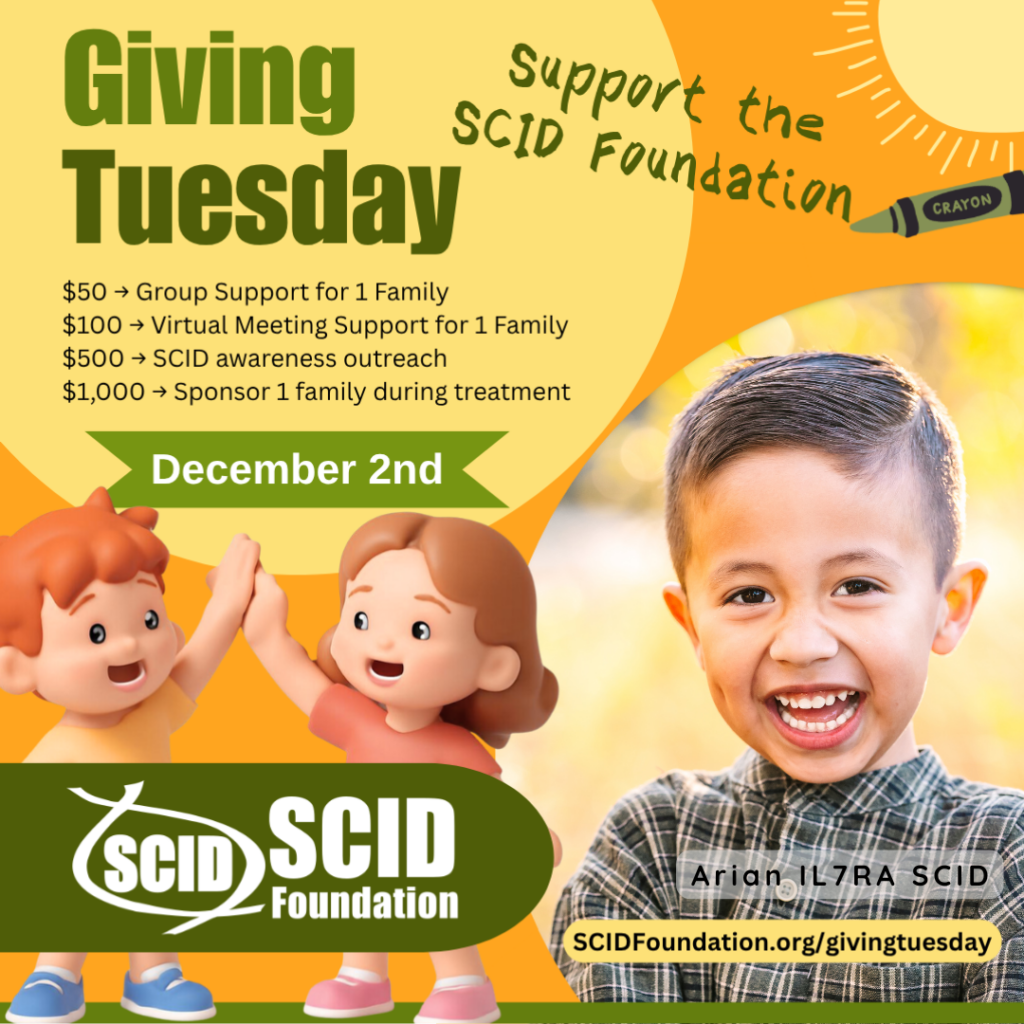
Every SCID Family Deserves Support From Diagnosis to Long-Term Follow-Up,
and that starts with you.
This Giving Tuesday, we need your help more than ever. The SCID Foundation can only continue providing education, support, and advocacy because you choose to give.
As more families turn to us, our resources are being stretched thin. Without increased support, we risk not being able to show up for every parent, caregiver, or patient who reaches out in crisis or who needs guidance.
Your Giving Tuesday gift—especially a monthly gift—creates the stability that SCID families depend on. You’re the reason they don’t face this journey alone.
Please give today and help keep this lifeline strong.
Thank you for considering the SCID Foundation as a part of your year end giving plan.
Know someone in the SCID Community who could use our news?
Encourage them to Sign up!